How to Communicate Better with Your Mother
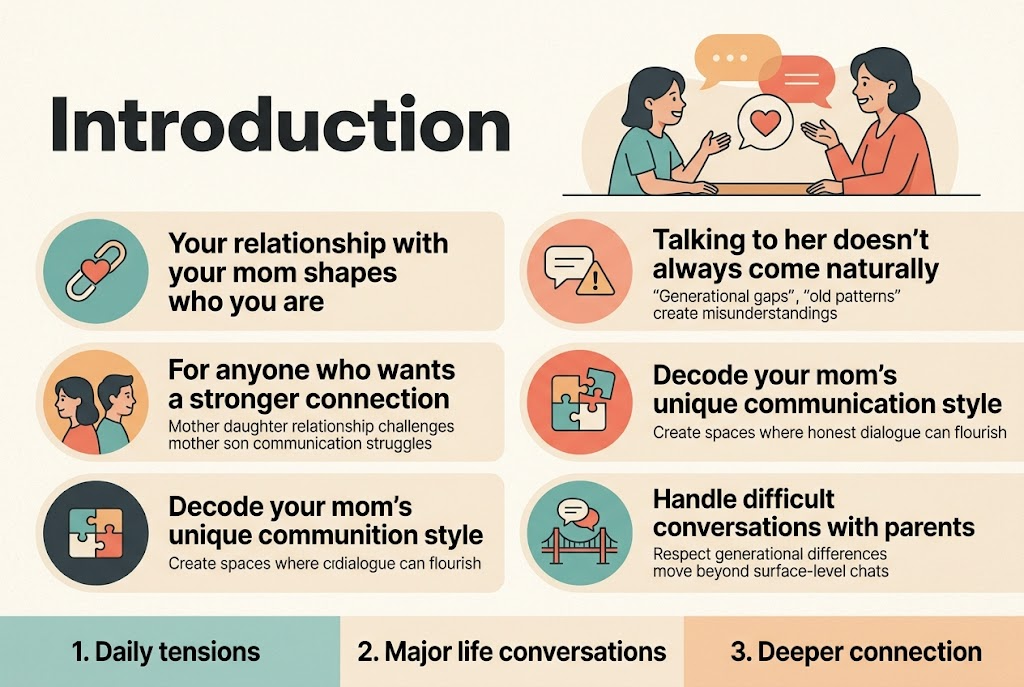
Your relationship with your mom shapes who you are, but talking to her doesn't always come naturally. Many adult children struggle with how to communicate with your mother, especially when generational gaps create misunderstandings or old patterns keep conversations stuck in the same frustrating loops.
This guide is for anyone who wants to build a stronger connection with their mom - whether you're dealing with daily tensions, preparing for major life conversations, or simply hoping to deepen your bond. You'll discover practical strategies that work for both mother daughter relationship challenges and mother son communication struggles.
We'll explore how to decode your mom's unique communication style and create spaces where honest dialogue can flourish. You'll also learn proven techniques for handling difficult conversations with parents while respecting generational differences that might be causing friction. These mother child relationship tips will help you move beyond surface-level chats to build the meaningful connection you both deserve.
Understand Your Mother's Communication Style
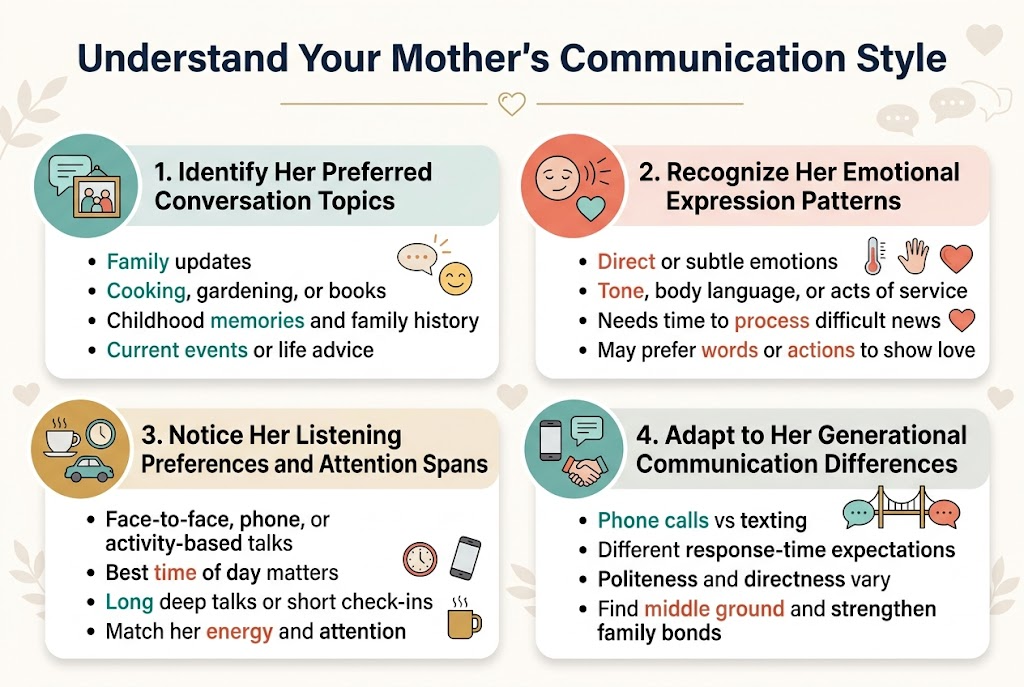
Identify Her Preferred Conversation Topics
Every mother gravitates toward certain subjects that light up her face and get her talking. Your mom might be passionate about family updates, cooking adventures, gardening triumphs, or her latest book club discussion. Pay attention to what makes her voice change when she talks – those are her sweet spots.
Some mothers love diving into childhood memories and family history, while others prefer discussing current events or sharing advice about life decisions. Notice which topics make conversations flow naturally versus which ones feel forced or create tension. When you learn how to communicate with your mother through her favorite subjects, you're building bridges rather than walls.
Recognize Her Emotional Expression Patterns
Understanding how your mother processes and shows emotions is crucial for improving mother daughter relationship dynamics and mother son communication alike. Some mothers are direct with their feelings, telling you exactly when they're frustrated, proud, or worried. Others express emotions more subtly through tone changes, body language, or even what they choose to cook for dinner.
Watch for her emotional rhythms too. Does she need time to process difficult news before discussing it? Does she get overwhelmed when multiple family members share problems at once? Some mothers express love through acts of service rather than words, while others need verbal affirmation to feel connected.
Notice Her Listening Preferences and Attention Spans
Your mother's listening style affects every conversation you have together. Some mothers prefer face-to-face talks over coffee, while others open up during car rides or while doing activities together. Phone calls might work perfectly for your mom, or she might be someone who needs visual cues to fully engage.
Consider her energy levels throughout the day. Morning people often have their best conversations before noon, while evening mothers might be more receptive after dinner. Some mothers can handle long, deep discussions, while others prefer shorter, frequent check-ins. Better family communication happens when you match her natural attention patterns rather than fighting against them.
Adapt to Her Generational Communication Differences
Generational communication differences play a huge role in talking to your mom effectively. Your mother might prefer phone calls over texting, or she might have different expectations about response times and conversation depth. She may value formal politeness in ways that feel outdated to you, or she might interpret directness as rudeness when you see it as honesty.
Her generation might also process conflict differently. While you might prefer addressing issues head-on immediately, she may need time to think things through or approach problems more indirectly. Understanding these differences doesn't mean changing who you are – it means finding middle ground that honors both your communication styles while strengthening family bonds.
Create Safe Spaces for Open Dialogue
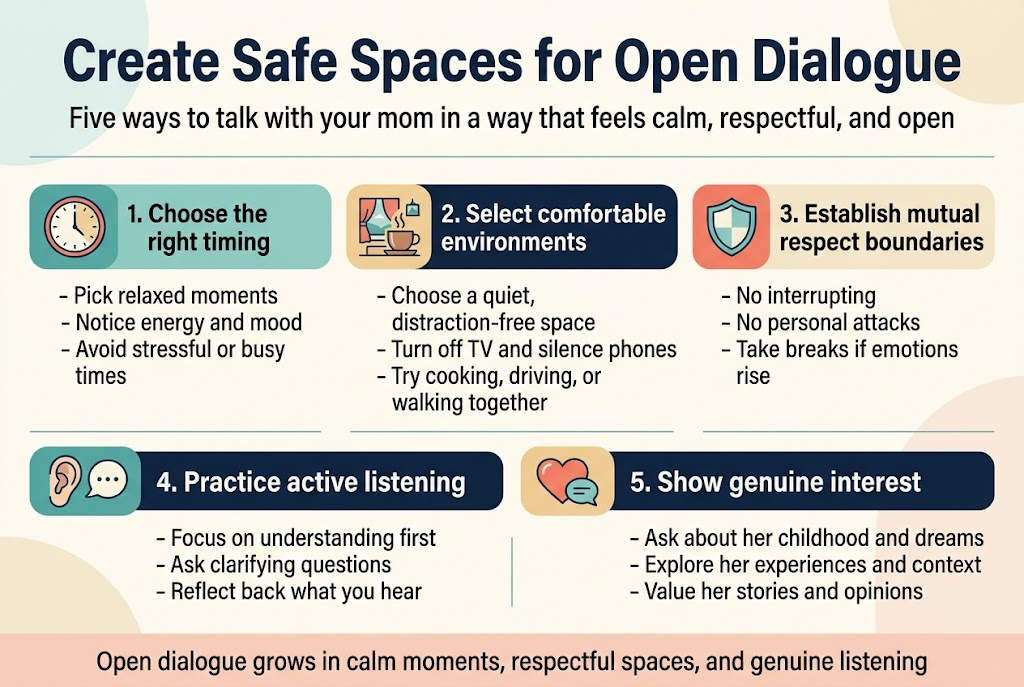
Choose the right timing for important conversations
Timing makes all the difference when you want to talk to your mom about something meaningful. You know how she gets when she's rushing to get ready for work or dealing with a stressful day. Pick moments when she's naturally more relaxed and receptive. Maybe that's Saturday morning over coffee, or after dinner when the day's chaos has settled down.
Pay attention to her energy levels and mood patterns. Some moms are morning people who think clearest before the world gets busy. Others need time to decompress after work before diving into serious topics. Watch for those natural openings when she seems present and engaged, not distracted or overwhelmed.
Avoid bringing up heavy subjects during family gatherings, holidays, or when she's multitasking. These moments rarely lead to productive conversations and often create unnecessary tension. Instead, give her the gift of your undivided attention by choosing times when you can both be fully present.
Select comfortable environments free from distractions
The setting for your conversation matters just as much as the timing. Your kitchen table might work perfectly for some families, while others might prefer a quiet walk around the neighborhood or sitting together in the living room. The key is finding a space where both of you feel comfortable and won't be interrupted.
Turn off the TV, put phones on silent, and create an atmosphere that says "this conversation is important." Some of the best mother-child conversations happen during shared activities like cooking together, driving in the car, or working in the garden. These settings often feel less intimidating than formal sit-down talks.
Consider your mom's preferences too. If she's always been more open during car rides, suggest running errands together. If she's a homebody who feels safest in her own space, respect that. The goal is creating an environment where honest communication can flow naturally.
Establish mutual respect boundaries
Healthy boundaries protect both of you during difficult conversations. Start by agreeing on some basic ground rules: no interrupting, no bringing up past grievances unless they're relevant, and no name-calling or personal attacks. These boundaries create safety for both of you to express yourselves honestly.
Respect works both ways in improving mother daughter relationship dynamics. You have the right to express your feelings without being dismissed, and she deserves the same courtesy. Set clear expectations about what topics are off-limits if certain subjects consistently lead to arguments without resolution.
Remember that boundaries aren't walls - they're guidelines that help conversations stay productive. You might agree to take breaks if emotions get too heated, or to revisit topics later if you're not making progress. These agreements show that you both value the relationship enough to communicate thoughtfully.
Practice active listening without judgment
Real listening means more than waiting for your turn to talk. When your mom shares something with you, focus completely on understanding her perspective before crafting your response. Watch her body language, notice the emotions behind her words, and resist the urge to immediately offer solutions or counterarguments.
Judgment kills open communication faster than almost anything else. Even if you disagree with what she's saying, try to understand why she feels that way. Ask clarifying questions like "Help me understand what that was like for you" or "What made you feel that way?" These questions show genuine interest in her experience.
Reflect back what you're hearing to make sure you understand correctly. Say something like "It sounds like you felt hurt when..." or "So you're worried about..." This technique, common in better family communication approaches, helps prevent misunderstandings and shows that you're truly listening.
Show genuine interest in her perspectives
Your mom has lived experiences and wisdom that shaped who she is today. Even if you don't always agree with her viewpoints, showing genuine curiosity about her perspectives can transform your conversations. Ask about her childhood, her dreams, her challenges, and what she's learned along the way.
Generational differences often create communication barriers, but they can also be bridges to deeper understanding. Instead of dismissing her views as outdated, explore the context that shaped them. What was happening in the world when she was your age? What challenges did she face that you might not understand?
Make space for her stories and opinions without immediately jumping to your own experiences. Sometimes the best gift you can give your mom is simply being interested in who she is as a person, not just as your parent. This approach often leads to surprising discoveries and stronger connections between you both.
Bridge Generational and Value Differences
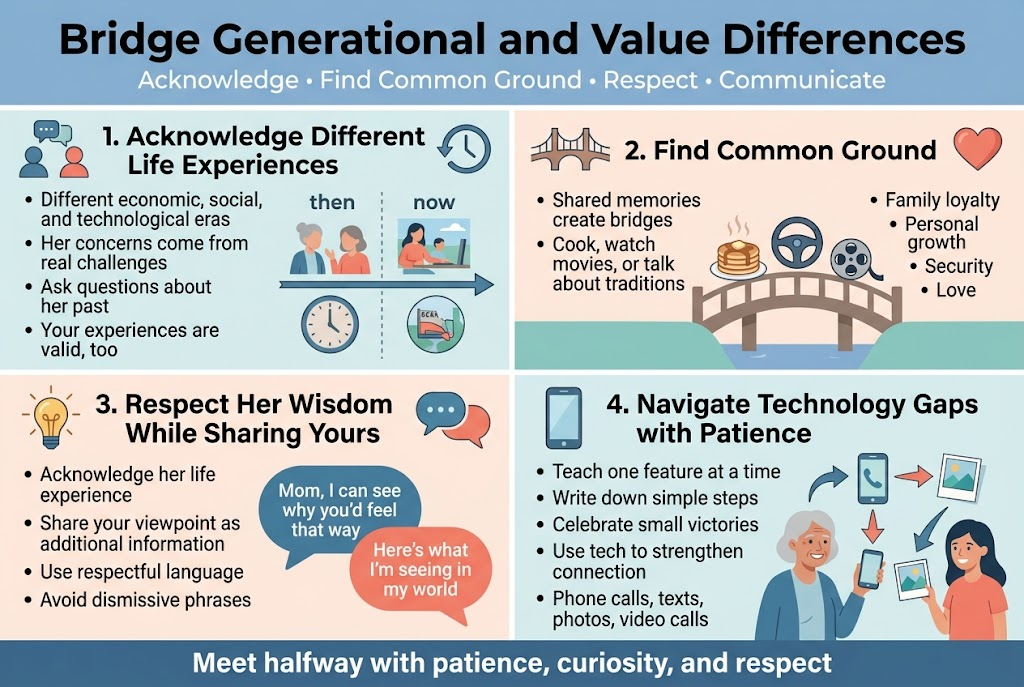
Acknowledge different life experiences and perspectives
Your mother grew up in a completely different world than you did. She lived through economic shifts, social changes, and technological revolutions that shaped her worldview in ways that might seem foreign to you. When she shares concerns about your career choices or lifestyle decisions, remember that her perspective comes from navigating challenges you've never faced. Maybe she watched her parents struggle through financial hardship, making job security her top priority. Perhaps she experienced discrimination that you've been fortunate to avoid.
Instead of dismissing her concerns as outdated, try asking questions about her experiences. "Mom, what was it like when you were starting your career?" or "How did your family handle money when you were growing up?" These conversations reveal the roots of her advice and help you understand why certain topics trigger strong reactions. When improving mother daughter relationship dynamics, this understanding becomes the foundation for meaningful dialogue.
Your experiences are equally valid but different. You've grown up with opportunities she never had, faced challenges she couldn't imagine, and developed skills in a rapidly changing world. Share specific examples of your generation's realities - like the gig economy, student debt, or changing relationship norms - without making her feel like her generation "doesn't get it."
Find common ground through shared memories
Shared experiences create bridges between generational gaps. Remember those Saturday morning pancake sessions? The way she taught you to drive? These moments reveal values you both hold dear - patience, care, tradition, and growth. Use these memories as starting points for deeper conversations about what matters most to both of you.
Create new shared experiences that honor both perspectives. Cook her favorite recipe together while she shares family stories. Watch movies from her era and discuss how they reflect the times she lived through. These activities naturally open doors for talking to your mom about topics that might otherwise feel contentious.
Look for values that transcend generational differences:
-
Family loyalty - You both want strong family connections
-
Personal growth - She wants you to succeed; you want to improve yourself
-
Security - Both of you value feeling safe and stable
-
Love - The core motivation behind most disagreements
When discussing difficult topics, anchor conversations in these shared values. Instead of focusing on what divides you, remind yourselves why you're having the conversation in the first place.
Respect her wisdom while sharing your viewpoint
Your mother has decades of life experience that brought her wisdom worth respecting, even when her conclusions differ from yours. She's witnessed patterns you haven't seen yet, made mistakes you might avoid, and learned lessons through trial and error. Acknowledge this wisdom explicitly: "I can see why you'd feel that way based on what you went through" or "Your experience with that situation gives you insights I don't have."
At the same time, you bring fresh perspectives shaped by current realities. Present your viewpoint as additional information rather than a contradiction. "Here's what I'm seeing in my world" or "My experience has been different because..." This approach creates space for both perspectives without invalidating either one.
Avoid phrases that shut down dialogue like "That's old-fashioned" or "Things are different now." Instead, build bridges: "I understand your concerns about X, and I've also noticed Y happening in my generation." This shows respect for her wisdom while adding your perspective to the conversation.
Navigate technology gaps with patience
Technology often creates the most visible generational communication differences in families. Your mother might feel overwhelmed by social media, confused by texting etiquette, or frustrated by constantly changing apps. Rather than sighing when she asks the same question about her phone for the third time, remember that she's learning an entirely new language.
Offer specific, patient help:
-
Set up her devices with clear, simple instructions
-
Teach one feature at a time instead of overwhelming her
-
Write down steps she can reference later
-
Celebrate small victories when she masters something new
Use technology to enhance your relationship rather than create distance. Send photos that make her smile. Share articles about her interests. Video call when you can't visit in person. Show her how technology can strengthen family communication rather than complicate it.
When she prefers phone calls over texts or wants printed photos instead of digital ones, respect these preferences. Better family communication means meeting each other halfway - sometimes that means picking up the phone instead of sending a quick text, and sometimes it means teaching her why texting works better for your schedule.
Handle Difficult Conversations with Grace
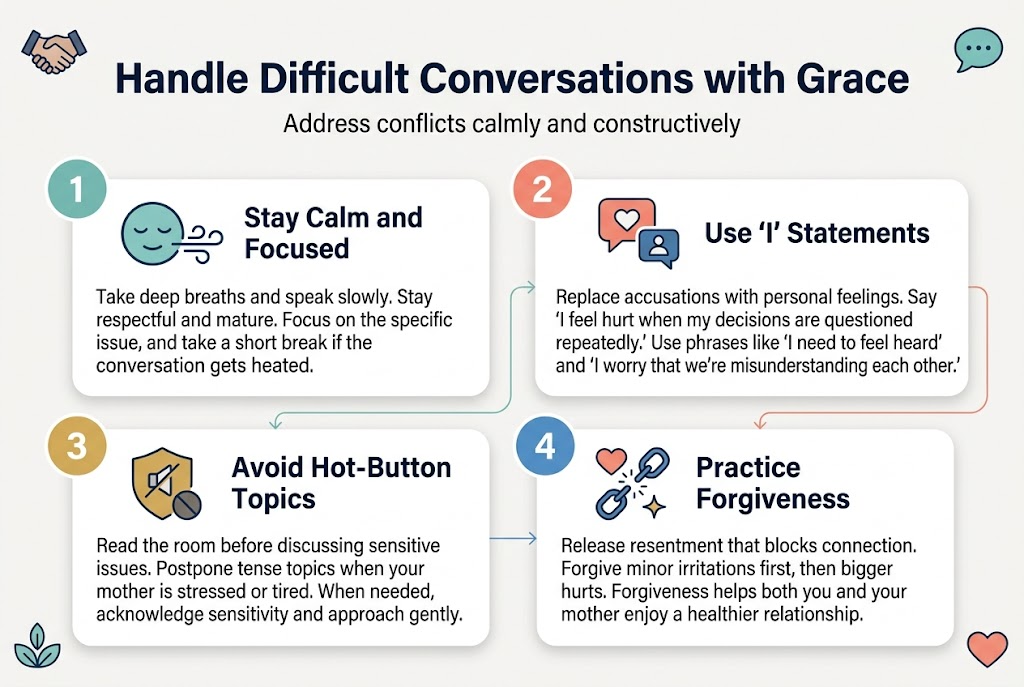
Address conflicts calmly and constructive
When tensions rise during difficult conversations with your mother, staying calm becomes your most powerful tool. Take deep breaths and speak slowly to maintain control over your emotions. Your mother likely has decades of experience handling family conflicts, so approaching her with respect and maturity will earn you better results than emotional outbursts.
Focus on the specific issue at hand rather than bringing up past grievances or unrelated problems. If the conversation becomes heated, suggest taking a short break to cool down. This shows emotional intelligence and prevents the discussion from spiraling into hurtful territory that damages your mother child relationship.
Use "I" statements to express your feelings
Transform accusations into personal expressions by using "I" statements when talking to your mom. Instead of saying "You always criticize my choices," try "I feel hurt when my decisions are questioned repeatedly." This approach removes the defensive element and helps your mother understand your perspective without feeling attacked.
"I" statements work particularly well for improving mother daughter relationship dynamics and mother son communication. They create space for empathy rather than defensiveness. Practice phrases like "I need to feel heard" or "I worry that we're misunderstanding each other" to keep conversations productive.
Avoid triggering sensitive topics unnecessarily
Every family has landmine topics that reliably cause explosions. Maybe your mother gets defensive about her parenting choices, your career decisions, or your lifestyle. While some sensitive subjects need addressing eventually, choose your battles wisely and pick the right moments for these discussions.
Better family communication means reading the room before diving into contentious subjects. If your mother seems stressed or tired, postpone conversations about money, relationships, or other hot-button issues. When you must address these topics, acknowledge their sensitivity upfront and approach them gently.
Practice forgiveness and let go of past grievances
Holding onto old hurts poisons your ability to communicate effectively with your mother today. This doesn't mean forgetting everything or accepting poor treatment, but rather choosing to release resentment that blocks genuine connection. Your mother made mistakes - just like you have - and continuing to punish her for past errors prevents growth in your relationship.
Start small by forgiving minor irritations before tackling bigger hurts. Strengthening family bonds requires this emotional generosity from both sides. Remember that forgiveness benefits you as much as your mother, freeing you to enjoy the positive aspects of your relationship without the constant weight of old anger.
Strengthen Your Relationship Through Consistent Communication
Schedule regular check-ins and quality time
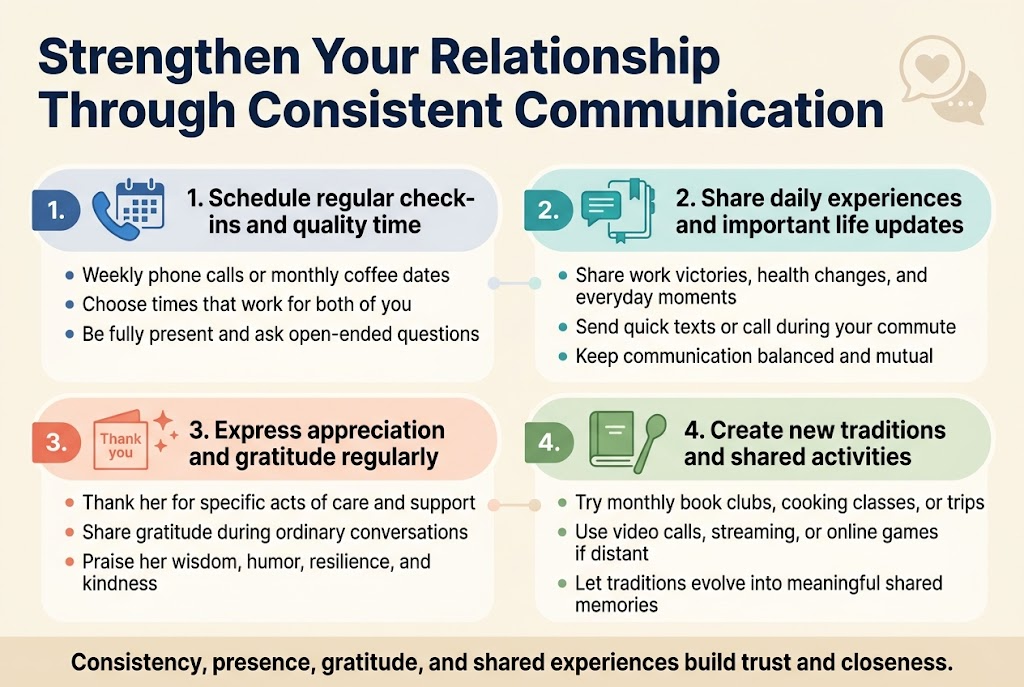
Building stronger communication with your mother starts with making regular connection a priority. Set up weekly phone calls or monthly coffee dates that both of you can count on. These scheduled moments become anchors in your relationship, creating predictable opportunities to stay connected even when life gets hectic.
Choose times that work for both your schedules. Maybe Sunday mornings work best for phone calls, or perhaps Saturday afternoons are perfect for grabbing lunch together. The key is consistency – when your mother knows she can expect to hear from you regularly, it reduces anxiety and creates a foundation of trust.
During these check-ins, focus on being fully present. Put away your phone, close your laptop, and give her your undivided attention. Ask open-ended questions about her week, her interests, and her feelings. This dedicated time shows that improving mother daughter relationship matters to you.
Share daily experiences and important life updates
Keeping your mother informed about your life – both the big moments and the everyday details – strengthens your bond significantly. Share work victories, relationship updates, health changes, and even mundane things like trying a new restaurant or watching a good movie.
Many mothers feel disconnected when they only hear about major life events after the fact. Including her in your daily narrative makes her feel valued and trusted. Send quick texts about funny things that happened during your day, or call during your commute to share something interesting you learned.
Create a balance between sharing enough to keep her involved without overwhelming her with every detail. Pay attention to what topics she responds to most enthusiastically – some mothers love hearing about work challenges, while others prefer updates about your social life or hobbies.
Remember that communication flows both ways. Ask about her daily experiences too. What's happening in her social circles? What books is she reading? How are her hobbies going? This mutual sharing creates a richer, more balanced relationship.
Express appreciation and gratitude regularly
Taking time to acknowledge what your mother means to you can transform your relationship dynamic. Many adults assume their mothers know they're appreciated, but hearing it explicitly makes a powerful difference in how to communicate with your mother effectively.
Thank her for specific things she did during your childhood – maybe how she always made your favorite meal when you were stressed, or the way she supported your dreams even when they seemed unrealistic. These detailed acknowledgments show you've been paying attention to her love and sacrifice.
Don't save appreciation only for big holidays or Mother's Day. Sprinkle genuine gratitude throughout regular conversations. Text her a quick "thanks for always believing in me" on a random Tuesday, or mention during your weekly call how her advice from last month helped you handle a difficult situation.
Express gratitude for who she is as a person, not just what she's done for you. Compliment her wisdom, her humor, her resilience, or her kindness. This helps her feel seen and valued as an individual, not just in her role as your mother.
Create new traditions and shared activities
Building fresh shared experiences gives you both something to look forward to and creates positive associations with spending time together. These don't need to be elaborate – simple, regular activities often become the most meaningful traditions.
Consider activities that match both your interests and energy levels. Maybe you start a monthly book club just for the two of you, take cooking classes together, or begin planning annual trips to places you both want to visit. The goal is finding activities that spark genuine enjoyment for both of you.
Technology can help bridge distance if you don't live nearby. Start watching the same TV series and text each other reactions, play online games together, or video chat while cooking the same recipe. These shared virtual experiences can be surprisingly connecting.
Pay attention to what brings out the best in both of you. Some mother-child pairs thrive during active adventures like hiking or shopping, while others connect better over quiet activities like puzzles or crafts. The activity matters less than the quality time and positive memories you're creating together.
Let these new traditions evolve naturally. If something isn't working, try something different. The goal is strengthening family bonds through enjoyable shared experiences that enhance your communication and deepen your relationship over time.
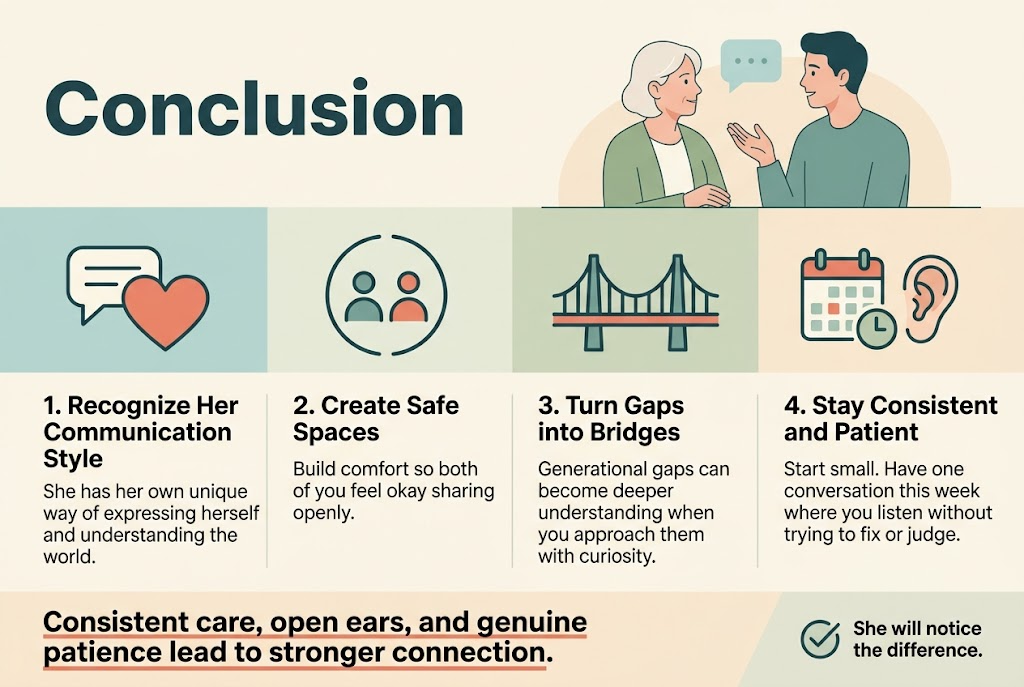
Improving communication with your mother starts with recognizing that she has her own unique way of expressing herself and understanding the world around her. When you take time to figure out her communication style and create safe spaces where both of you feel comfortable sharing, you're already halfway there. Remember that generational gaps don't have to be roadblocks – they can actually become bridges to deeper understanding when you approach them with curiosity instead of frustration.
The secret to lasting change lies in consistency and patience. Those difficult conversations will get easier when you practice handling them with grace, and your relationship will naturally grow stronger as you keep showing up with genuine care and open ears. Start small, maybe with one conversation this week where you really listen without trying to fix or judge. Your mother will notice the difference, and you might be surprised at how much closer you can become when you both feel truly heard and valued.
.png)


Comments
Post a Comment